Friday, April 8, 2011

Brussels Sprouts Please!

Ok kids (and adults), it's time to give Brussels Sprouts a try. Believe it or not, my daughter was first exposed to Brussels Sprouts on a cartoon show. (It amazes me the vegetables I have YET to introduce to her... I'll be on a mission now to expose the fruit and vegetable world!)

So after seeing those green little veggies on Olivia, she said... "Mom, what are Brussels Sprouts?" Knowing she was a huge fan of raw food and cabbage, I said "They are like little baby cabbages". Then she immediately asked to go to the store and buy them. So we did.

We brought them home and she looked at them with a smile. She immediately bit into one and was thrilled! They did taste like baby cabbages! And how fun they were too. Eat them in balls or peel them and eat the leaves one at a time! That was two days ago. Since then, she's asked for them over and over again.

The lesson? Continue to introduce new foods to your children. Just because you don't eat them or don't think they would like them is no reason to leave it out of the equation. You'd be surprise what kids will like (especially the more foods they are exposed to). Give them the benefit of the doubt and make it fun. Kids gravitate toward raw foods, so try raw versions first. Cooking vegetables can spoil the whole experience for kids.

So give those little green balls of nutrition a try! You just might like it!

Friday, April 1, 2011

Don't Be Fooled, Food Dyes Affect Children

It's April Fool's Day, but don't be fooled by thinking artificial food colorings are not harmful to our kids just because the FDA has decided thus far not to put "warning labels" on their products. Numerous studies suggest that food dyes and food colorings negatively impact the health of our children, and adults. When at the market, find foods that have natural, plant colorings instead of the synthetic number-coded colorings. Or better yet, choose colorful whole food! Think RED STRAWBERRY, ORANGE ORANGES, GREEN SNAP PEAS, BLUE BERRIES, YELLOW BANANAS... Nature is very colorful on her own, when you stick to "nature's food".

Here are some related food coloring and food dye articles:

Scientists Warn: Food Colors Damage Kids
A recent study reported in the journal Prescrire International found that artificial food dyes are linked to an increased incidence of hyperactivity in children. Scientists studied 297 children who were representative of the general population to conclude that food colors increase hyperactivity in children, not just children who are sensitive to them.
... In another study published in the Journal of Pediatrics, the dye tartrazine was linked to behavioural disturbances in normal children. Still more research from doctors at the University of Southampton in the United Kingdom found that food dyes have a significant impact on the behaviour of normal children and boost the levels of hyperactivity. These doctors also recommended that these additives be removed from children’s diets.

Read more: http://www.care2.com/greenliving/scientists-warn-food-colors-damage-kids.html

Artificial Food Coloring Dangers
Artificial food coloring ingredients (food dye) contain plenty of chemicals. Many are derived from highly toxic sources and can cause many different diseases, disorders, and mutations in humans. Although it seems unlikely that a trivial amount of food coloring in a piece of a candy you eat (like liquorice) would have any harmful effect on you, you would be wrong, because it does.

Friday, March 18, 2011

Super Moon Sat. March 19th!


Here is a great little video to share with the kids and then get outside at "moon rise" tomorrow (Sat) night to experience the first super moon since 1983!

Saturday, March 12, 2011

Diet Instead of Drugs, May Help Kids with ADHD

It is now being learned, that a high percentage of children diagnosed with ADHD are simply experiencing a hypersensivity to food. Remove the reactive food and you remove the cause of "dis-ease", and find a sense of "ease" again.

Here is an excerpt of a great article by NPR regarding the study.

Kids with ADHD can be restless and difficult to handle. Many of them are treated with drugs, but a new study says food may be the key. Published in The Lancet journal, the study suggests that with a very restrictive diet, kids with ADHD could experience a significant reduction in symptoms.

The study's lead author, Dr. Lidy Pelsser of the ADHD Research Centre in the Netherlands, writes in The Lancet that the disorder is triggered in many cases by external factors — and those can be treated through changes to one's environment. ...

According to Pelsser, 64 percent of children diagnosed with ADHD are actually experiencing a hypersensitivity to food. Researchers determined that by starting kids on a very elaborate diet, then restricting it over a few weeks' time. ...

But diet is not the solution for all children with ADHD, Pelsser cautions.

"In all children, we should start with diet research," she says. If a child's behavior doesn't change, then drugs may still be necessary. "But now we are giving them all drugs, and I think that's a huge mistake," she says. ...

"We have got good news — that food is the main cause of ADHD," she says. "We've got bad news — that we have to train physicians to monitor this procedure because it cannot be done by a physician who is not trained."
[Read full NPR Article: Study: Diet May Help ADHD Kids More Than Drugs: 3/12/11]
Read the study in The Lancet

Sunday, March 6, 2011

Feeding Kids Salads


Give kids a chance to like fresh, living foods. Beyond the regular finger foods of carrot and celery sticks, expose them to tasty salads. It's ok. Let them play with their food. The other night I served my 6-year-old some rice pasta and marinara sauce along with a small bowel of cabbage, carrot, and cilantro salad (no dressing). After only 2 bites of the pasta, she literally pushed her bowl aside and grabbed her bowl of salad. Gobbled it down and had 2 more helpings! This is now one of her favorites! "I could sing my mouth is so happy!" she told me.

So how do you get kids to like living salads?
  • Expose them to the salad at high-hungry times (after physical activities, snack times, before meals). So what if they fill up before dinner... it's the best thing they can eat!
  • Eat living salads yourself, and often (do as I do, not as I say)
  • Make games of it: "Are you a rabbit?? Here's your munchy, crunchy meal!"
  • Ask them intriguing questions: "Can you tell the difference between the red and green cabbage?"
  • Constant exposure pays off. It may take 1 or 250 times before they'll try it, but persistence pays off, especially when they are hungry. It becomes a "known factor" to them. So keep it visible!
  • Be Creative and let them gravitate towards their natural instincts to eat living food.

Friday, October 29, 2010

Healthy Halloween Treat

- From RawMom.com

If you don't want to give sugary 'treats' to the little angels and goblins knocking at your door - why not have some fun with your kids making these cute little guys.


Ingredients are per 'pumpkin'

1 clementine
12x12 square cling wrap
1" clear tape
scraps of felt, cut for eyes , nose, mouth, or googly eyes:)
twist tie
silk ivy leaf
green floral tape
glue, if not using self stick felt or googly eyes

Preparation:

1. Wrap clementine in cling film and twist tightly.
2. Secure at top with clear tape.
3. Cover clear tape with green floral tape, snip to desired length.
4. Attach ivy leaf to twist tie with floral tape, cover entire length of tie with tape.
5. Twist leaf/tie around stem as desired.
6. Apply face as desired.

Note: choose self-stick felt for really little children. This is a great one to have the kids make with you...they create the cutest faces!

(Thanks to RawMom.com for this great idea. Click here for some other fun Halloween treats).

Thursday, October 7, 2010

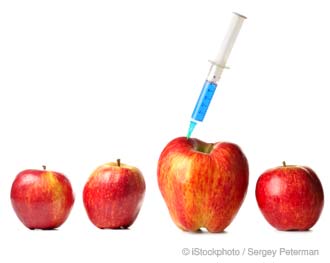
GM Foods Dangerous to Children


Excerpts from Mercola.com.

“Swapping genes between organisms can produce unknown toxic effects and allergies that are most likely to affect children.”

--Vyvyan Howard, expert in infant toxico-pathology at Liverpool University Hospital, United Kingdom


An FAO/WHO task force on GM food said that “Attention should be paid to the particular physiological characteristics and metabolic requirements of specific population subgroups, such as infants [and] children.”

In practice, GM safety assessments ignore them.

In fact, industry-funded studies often use mature animals instead of the more sensitive young ones, in order to mask results. Biologist David Schubert warns:

“Since children are the most likely to be adversely effected by toxins and other dietary problems, if the GM food is given to them without proper testing, they will be the experimental animals. If there are problems, we will probably never know because the cause will not be traceable and many diseases take a very long time to develop.”

To learn more about the health dangers of GMOs, and what you can do to help end the genetic engineering of our food supply, visit www.ResponsibleTechnology.org.

To learn how to choose healthier non-GMO brands, visit www.NonGMOShoppingGuide.com.


{Read Full Article}